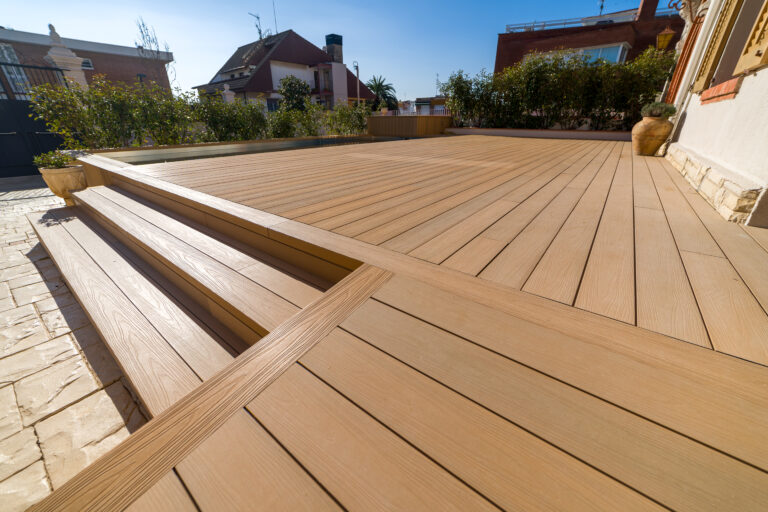
Deck maintenance
How Often to Stain a Deck in Florida (and When to Stop Staining)
A realistic staining schedule for decks in Palm Beach County: how long each type of finish lasts in Florida sun and wet season humidity, the signs a deck is due, and how composite or hardwood on an aluminum frame ends the cycle.
Why decks in hot, humid climates need stain more often
Sunlight breaks down the surface of exterior wood, and repeated wetting and drying makes the boards swell and shrink. The USDA Forest Products Laboratory lists what follows on a deck without proper maintenance: checks and cracks, raised grain and mildew, which in turn raise the risk of decay and insect attack. In Florida, every one of those drivers runs at full strength for most of the year.
The National Weather Service office in Miami defines the South Florida wet season as May 15 to October 15, the months that bring 60 to 70 percent of the average yearly rainfall. Through that season, surface dew points sit in the 70s almost daily and showers and thunderstorms develop nearly every day. West Palm Beach averages 36.30 inches of rain in the wet season alone, based on 1991 to 2020 normals. A deck that is soaked most afternoons and baked most mornings spends little time fully dry, so a finish whose job is to keep water out is working constantly.
Mildew is the third pressure. Pigment in a stain shields the wood and the mildewcide in the finish from sunlight, according to the Forest Products Laboratory, so mildew gains ground as the pigment wears thin. Sherwin-Williams notes that it grows in areas that are dark and moist with limited air movement, which on a deck means the strip along the house wall, the boards under planters and the space beneath outdoor furniture.
A realistic staining schedule for Palm Beach County
Sherwin-Williams gives every two to three years as the commonly accepted guideline for deck staining, and names the factors that move it: the type of wood, the type of stain, how heavily the deck is used and the climate. Manufacturer ratings for individual products run longer, but they are stated as maximums, and the conditions behind them are not published. For a deck in full sun in Palm Beach County, plan around the low end of each range and let a yearly inspection set the exact date. The steps, the path to the pool and the boards in afternoon sun lose their finish well before the shaded corners, so the most exposed boards set the schedule.
| Finish type | Rated life on deck surfaces | How to plan it in Palm Beach County |
|---|---|---|
| Clear water repellent | About 1 year (USDA Forest Products Laboratory); up to 1 year on horizontal surfaces for Behr’s entry protector | Renew every year, ideally in the dry months before the wet season |
| Transparent stain | Up to 2 to 4 years on horizontal surfaces, depending on the Behr product line | Inspect every year and expect the low end on boards in full sun |
| Semi-transparent stain | Up to 2 to 6 years on horizontal surfaces across Behr product lines; 2 to 3 years as the general deck guideline (Sherwin-Williams) | Plan on the 2 to 3 year guideline and recoat sooner if the water test fails |
| Solid color stain | Up to 5 to 10 years on horizontal surfaces across Behr product lines | Inspect every 2 to 3 years (Cabot’s interval for decks) and watch for peeling in traffic lanes, since it forms a film |
Signs your deck is due
The quickest check is the water drop test Sherwin-Williams recommends before staining: sprinkle water on the boards, and if the wood absorbs the droplets, it is ready for stain. Run it across the sunniest boards first, and plan any recoat for a day with no rain in the forecast, at least 24 to 48 hours after the last rain.
Water soaks in
Droplets darken the wood within moments instead of sitting on the surface.
Gray or silver boards
Wood that has lost its natural color can look colored when wet and silver when dry, per the Forest Products Laboratory.
Uneven fading
Traffic lanes and sun-facing boards look lighter than the areas under furniture or in shade.
Mildew patches
Dark spotting along the house wall, under planters and in corners with little air movement.
Checks and raised grain
Small cracks along the board and a rough surface, the early damage the laboratory links to skipped finishing.
Loose boards or soft spots
Part of Cabot’s inspection list for decks, along with cracks and fungus. Repair these before any recoat.
Stain, paint or coating: which deck finish lasts longer
Homeowners comparing deck stain, deck paint and deck coatings in West Palm Beach are choosing between two families of finish, and they behave differently in a humid climate.
Penetrating stains soak into the wood rather than forming a layer on top. The USDA Forest Products Laboratory recommends them for deck surfaces, along with water-repellent preservatives, because they perform better overall and are easier to reapply. A semi-transparent stain does not blister or peel even when excess moisture gets into the wood; it wears away gradually.
Paint and solid color stain form a film. Sherwin-Williams points out that paint traps moisture, which can lead to wood damage, while stain lets it escape. The Forest Products Laboratory adds that film-forming finishes on decks are prone to fail by peeling and wear excessively in high-traffic areas, although they can perform well on railings.
Deck coatings, the thicker resurfacing products applied over worn boards, are film-forming as well, and the same concern applies: water that gets underneath has a harder time leaving. Before choosing one, ask the applicator how the product handles moisture already in the wood and what recoating involves once it wears. For most wood decks in Palm Beach County, a penetrating semi-transparent stain on a regular schedule is the finish the evidence supports. It also commits the owner to recoating every few years for as long as the deck stands.
What the stain cycle really costs over time
The price of a single recoat is only part of the cost. Each cycle includes cleaning the deck, letting it dry, moving furniture and planters, the product, the labor to apply it and the days the deck is out of use. The Forest Products Laboratory advises at least two warm, windy days of drying after cleaning before a finish goes on, and Sherwin-Williams advises waiting 24 to 48 hours after rain. During the wet season, finding that dry window can add days of its own.
Frequency multiplies all of it. At the two to three year guideline, a deck kept for 20 years goes through seven to ten finish applications, counting the first. Deferring a cycle saves the recoat but leaves the boards exposed, and the Forest Products Laboratory notes that most decks are retired because of cracks and checks that timely finishing could mostly have avoided.
For a hotel, restaurant or rental property, each cycle also means closing the space. For architects and contractors specifying a deck, the useful comparison is the total over the expected life of the project, recurring cycles included, rather than the installed price per square foot alone.
Getting off the stain cycle: composite and hardwood on an aluminum frame
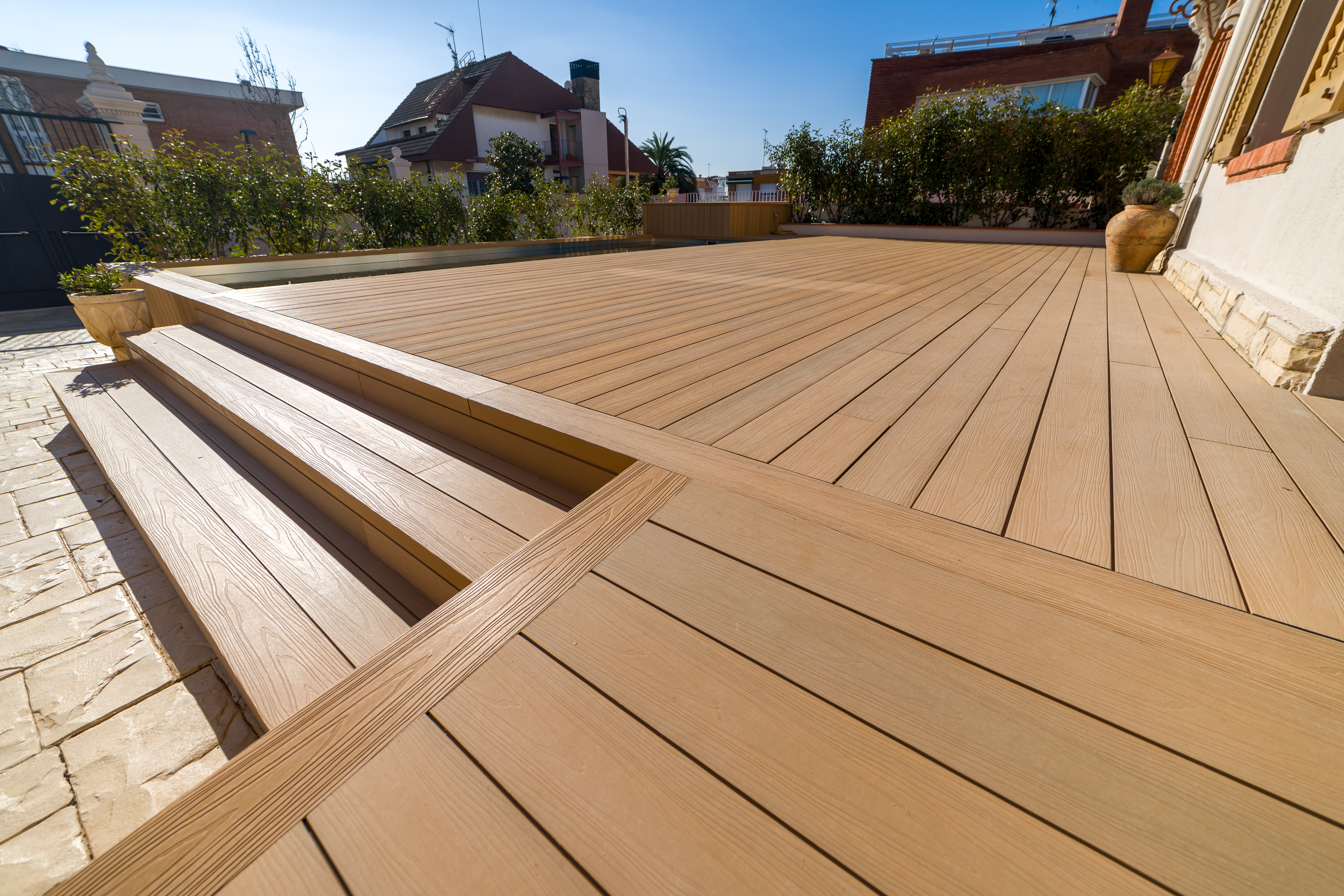
The stain cycle exists because wood needs a finish to hold its color and shed water. The way off it is a surface that does not depend on a finish, such as Exterpark’s composite decking, installed on an aluminum frame with the patented Shark Clip hidden fastening system.
Exterpark Tech (composite)
Composite boards designed to be used without stain, sealer or paint. Exterpark Tech carries a 20-year warranty against fading under normal use, so there is no color to refresh and no recoat to schedule.
Exterpark Wood (hardwood)
For projects where real timber is the point: Ipe, Kumaru, Teak (including FSC-certified Teak) and thermo-treated wood. Hardwood still weathers and still needs a finish to keep its original color, so the schedule stays. What changes is the frame underneath and the access to every board.
Aluminum frame and Shark Clip
Both lines install on an aluminum substructure that termites cannot damage and that does not rust. The Shark Clip leaves no visible screws, won the Most Innovative Construction Tool award at the International Builders’ Show and, according to Exterpark, installs up to three times faster. Every board is individually removable, so a damaged board can be replaced on its own and the space underneath stays open for cleaning or running cable.
Decks in West Palm Beach, Jupiter and Palm Beach Gardens
Across Palm Beach County, deck maintenance in Florida follows the conditions above, with differences from one property to the next. A pool deck in full sun, a terrace under a tree canopy and a waterfront deck with no shade at all each wear at their own pace, which is why the most exposed boards should be inspected first instead of assuming one date for the whole surface.
If you are planning a new deck or replacing a worn one, our pages on West Palm Beach composite decking, Jupiter and Palm Beach Gardens cover the options in each city. Exterpark USA works from a warehouse in Hialeah, Florida, through its authorized distributor, Cedro Rojo.
Common questions
Florida Deck Staining FAQ
Short answers to the questions Florida homeowners, architects and contractors ask most about deck stain.
01How long does deck stain last in Florida?
02What if it rains after I stain my deck?
03What happens if you don’t stain your deck?
04Is stain or paint better for a deck in Florida?
05Can you stain composite decking?
06Does composite decking need less maintenance than wood?
Plan a Deck Without a Stain Schedule
Send us the square footage, the location and how the deck will be used, and we will recommend the surface and the frame that fit the project. Write to usa@exterpark.com or use the contact form.